
Your Wildfire Preparedness Guide
Stay Safe, Informed, and Prepared for Wildfire Season
Wildfires can strike quickly, but with the right knowledge and preparation, you can take meaningful steps to protect what matters most. This guide brings together essential information on home hardening, defensible space, evacuation readiness, Go Bag planning, air quality safety, and caring for pets and livestock during emergencies. Whether you’re fortifying your property, preparing your household, or supporting your community, you’ll find practical, easy-to-follow steps to help you stay ready before, during, and after a wildfire.
Wildfire Safety Overview
Stay Wildfire Ready
Fire plays an essential role in maintaining soil and ecosystem health. Fire is not inherently destructive—imbalances in the environment create conditions that feed fires and transform them from a natural occurrence that has countless benefits to the land, animals, and even people, to a catastrophic event that destroys land, ecosystems, infrastructure, and people.
This is why wildfire mitigation efforts are so critical in caring for the landscape and our built environment, so that we ensure we can reap the benefits of fire and decrease the potential for destruction.
Fire is essential for the health of many California ecosystems, but uncontrolled wildfires can spread rapidly into communities. You can keep your family, home, and community safe by planning ahead and taking key steps to be prepared.
What Makes Wildfire a Serious Threat?
Wildfires are uncontrolled fires that burn in wildland vegetation, such as grass, brush, or forest, and they can ignite naturally or from human activity. Fire itself is natural and essential for healthy ecosystems, as it recycles nutrients, supports habitats, and maintains fuel balance on the land.
The challenge comes as more people live in the Wildland Urban Interface or WUI (pronounced woo-ee), the areas where neighborhoods intermingle with wildlands. In these settings, wildfire can spread rapidly into communities. At their most extreme, they can escalate into urban conflagrations: large destructive fires that jump from home to home, business to business, or structure to structure, and overwhelm entire neighborhoods. Wind blown embers can travel miles ahead of fire and ignite vegetation and structures. Most homes in California are lost this way.
These events not only put people, homes, and local economies at risk, they also damage watersheds, wildfire habitat, and the long-term health of California’s landscapes. Wildfire smoke adds another layer of harm, with links to respiratory disease, cardiovascular illness and cancer. Because the impacts reach across health, ecosystems, and communities, it’s critical we stay informed, prepared, and alert to the risks of wildfire.
Stay Informed
Sign up for emergency alerts in your county at Cal Alerts.
Look up local alerts at Listos California.
Visit CAL FIRE and your local fire department to get the latest wildfire info.
Stay Prepared





Stay Alert
Red Flag Warnings are issued by the National Weather Service. This alert means warm temps, low humidity, and strong winds are creating extreme fire danger within 24 hours. Follow local fire department instructions, avoid activities that could spark a fire, and be ready to evacuate immediately if a Red Flag Warning is issued. This is a critical time to stay and be alert.
Strong wind events can contribute to the increase in severity of wildfires. Check the National Weather Service for watches, warnings, and advisories.
A PSPS (Public Safety Power Shutoff) may be implemented by electric investor-owned utilities (IOUs) as a measure of last resort. This action means the utility may proactively cut power to electrical lines if it reasonably believes there is an imminent and significant risk that strong winds could topple power lines or cause major vegetation-related issues, increasing the risk of wildfires.
It’s vital to stay alert for wildfire smoke and to report suspicious smoke or fire. If you suspect an arson-caused fire, call the CAL FIRE anonymous hotline at
1-800-468-4408.
Evacuation Alerts
Evacuation Warning
Potential threat to life and/or property.
Those who require additional time to evacuate, and those with pets and livestock should leave now.
Evacuation Order
Immediate threat to life. Leave now!
This is a lawful order to leave now. The area is lawfully closed to public access.
Shelter in Place
Go indoors. Shut and lock doors and windows.
Prepare to self-sustain until further notice and/or contacted by emergency personnel for additional direction.
What to do?
- Follow local fire department instructions and monitor alerts.
- Remove flammables near your house and avoid any activities that could spark a fire.
- Grab your go bag, corral pets, and be ready to evacuate immediately if an Evacuation Warning is issued.
- If you need assistance, call your designated support in your safety plan, or if you are support, check in on those you are assisting.
Be Prepared for a Power Outage
- Know where your circuit breakers or fuse boxes are located and how to check them.
- Keep your natural gas and electric company’s emergency numbers readily available.
- If you use a generator, ensure it has been installed by a licensed electrician.
- Have an emergency plan in place for your household so everyone knows what to do during an outage.
Handling Refrigerated Medication During a Power Outage
- Keep fridge closed to hold in the cold.
- Move medicine to a cooler with ice or cold packs.
- Use a thermometer to check the temperature (should stay 36–59°F).
- Don’t let medicine touch the ice—it could freeze.
Cultural Fire
Good Fire II: Current Barriers to the Expansion of Cultural Burning and Prescribed Fire Use in the United States and Recommended Solutions, by Sara A. Clark, Bill Tripp, Don Hankins, Colleen E. Rossier, Abigail Varney, and Isobel Nairn for The Karuk Tribe
Prescribed Fire
Prescribed or controlled burns are planned, carefully managed fire used to reduce wildfire risk, improve habitats, and restore ecosystems. Controlled burns are an essential tool for managing hazardous fuels, including flammable live and dead vegetation like needles, grasses, branches, shrubs, and downed trees. Burn decisions are made daily based on numerous conditions, such as weather and air quality to control smoke. In controlled burns, aside from the prescribed fire itself, fuels can be removed through thinning, pruning, or chipping.
How can you distinguish a controlled/prescribed/beneficial fire from an uncontrolled wildfire?
Download the California Air Resources Board’s (CARB) California Smoke Spotter app. The app provides a comprehensive overview of the latest information on prescribed fires, projected smoke impacts, current air quality and educational material.
Defensible Space + Home Hardening
Protect Your Home Against Wildfires
Most homes ignite from wind-driven embers, not direct flame. Defensible space and home hardening work together to reduce the likelihood of ignition and increase your home’s chances of survival during a wildfire.
What is Defensible Space?
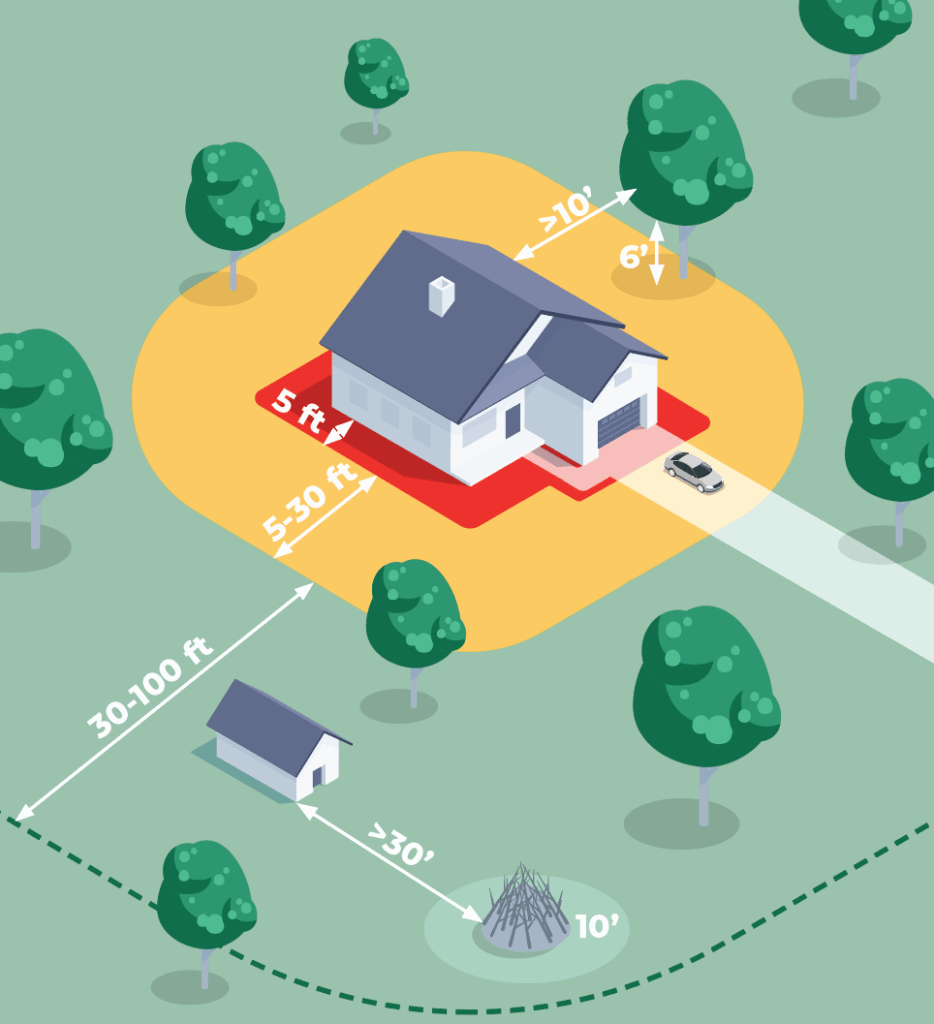
Defensible space is the buffer zone between your home and surrounding vegetation and buildings that helps slow or stop the spread of fire that would otherwise overtake your property. It also provides firefighters with a safer area to defend your property. There are three zones of defensible space that must be addressed in order to improve your home’s chances of surviving wildfires.
Zone 0 (0 – 5 ft)
Ember Resistant Zone
Most critical. Keep this area clear of anything that might catch fire.
Remove all vegetation, including grass, ornamental or native plants, shrubs, fallen leaves and tree needles, weeds, and combustible mulches including bark and woodchips. You can landscape this area beautifully with stone or gravel.
Keep any green plants in this area in 5 gallon pots away from a vent, door, or window.
Clear debris from your roof, gutter, deck, porch, stairways, and under any areas of your home.
Trees do not need to be removed, but ensure any branches are cut back to at least 5 feet from the home and 10 ft from chimneys and stovepipe outlets. Remove any dead branches.
Replace wood fences in the first 5 ft from the home with fences made of metal or concrete.
Avoid storing combustible items near the home (furniture, woodpiles, sheds, etc).
Zone 1 (5-30 ft)
Keep it lean, clean, and green
Remove dead vegetation and regularly clear dead or dry vegetation and create space between trees.
Trim trees regularly to keep branches a minimum of 10 feet from other trees and branches 6ft from the ground (or 1/3 of the tree height).
Make sure shrubs and bushes are well spaced (at least 2x the size of the plant).
Avoid storing combustible items near the home (furniture, woodpiles, sheds, etc).
Zone 2 (30-100 ft)
Space it out
Cut or mow grass down to a maximum height of four inches.
Create horizontal and vertical space between grass, shrubs, and trees.
Remove fallen leaves, needles, twigs, bark, cones, and small branches. However, they may be permitted to a depth of three inches.
Store wood piles 30’ from structures and keep 10 feet of clearance around exposed wood piles, down to bare mineral soil, in all directions.
Clear areas around outbuildings and propane tanks. Keep 10 feet of clearance to bare mineral soil and no flammable vegetation for an additional 10 feet around their exterior.
Defensible Space Zones – 0, 1, and 2 are subject to change, pending the release of the Board of Forestry and Fire Protection’s complete rulemaking and final regulations.
What Is Home Hardening?
Home Hardening makes your home safer from wildfire by upgrading key building features with fire-resistant materials and using design elements that make homes less likely to ignite during a wildfire. It also involves maintaining vegetation and landscaping in ways that reduce fire risk. Some materials are naturally fire-resistant, while others are treated to better withstand flames. Your goal is to seal any areas that embers can intrude. Small upgrades can significantly increase your home’s resilience.
Fire-resistant building materials and designs include:

Class A-rated roof coverings

Non-Combustible Siding
Ember-Resistant Vents & Gutter Covers

Double-Pane Tempered Glass Windows
Fully Enclosed Eaves

Non-Combustible Fencing Within At Least 5 Feet
Decks, Stairs, and Pergolas
Use noncombustible materials where possible, especially for the first few feet from the home. Don’t store anything under your deck, enclose decks that are less than 4 ft from the ground with a noncombustible materials, and keep flammable materials off the deck.
Defensible Space + Home Hardening Resources
Download the Fire Safe Business Directory to find a contractor who can assist you with home hardening and defensible space.
Find your county coordinator who can assist you with local resources and programs.
Find your local fire safe council to ask about local resources and programs.
Evacuation Preparedness + Go Bag Prep
Be Ready and Equipped for the Next Wildfire
Time is of the essence when evacuating from a wildfire. The most critical step to ensuring you are informed and quick to act and evacuate in the safest manner possible is signing up for emergency alerts. Embers, smoke, and road closures can occur before flames arrive, so early action is critical. It is important to evacuate early!
iPhone: Steps to Turn on Emergency Alerts
iPhone Steps
- Navigate to iPhone Settings.
- Select Notifications.
- Scroll to the bottom of the Notifications section to GOVERNMENT ALERTS.
- Next to Public Safety Alerts, toggle the button on (it turns green). These alerts convey “recommendations for saving lives and property.”
- Select Emergency Alerts.
- On the following screen, ensure that Emergency Alerts are toggled on.
- According to Apple, the Local Awareness option improves the timeliness and accuracy of emergency alerts in the United States. Toggle to enable or disable.
- You may also toggle on Always Play Sound, which ensures that emergency alerts can play a sound event if your iPhone is in silent mode.
Android: Steps to Turn on Emergency Alerts
Android Steps
- Navigate to Android Settings.
- Scroll down and select Safety & emergency.
- Select Wireless emergency alerts at the bottom of the screen.
- On the following screen, ensure that Allow alerts is toggled on.
- Toggle Extreme threats and Severe threats to enable or disable alerts for threats to life and property.
- Toggle Public safety messages to enable or disable alerts with recommended actions to save lives or property.
Other Resources
Ready, Set, Go!
Ready
Before a Red Flag Warning has been issued.
- Make a plan.
- Prepare your go bag.
- Sign up for emergency alerts.
Set
During the Red Flag Warning
- Monitor for alerts and prepare your family for an evacuation.
- Remove flammables from nearby your house.
- Grab your go bag and corral your pets.
Call your designated support in your safety plan if you are in need of assistance.
Go!
Act early when a wildfire threatens your area
- Evacuate early/ASAP when you get an Evacuation Warning.
- Always listen to your first responders!
Red Flag Warnings
Red Flag Warnings are issued by the National Weather Service. This alert means warm temperatures, low humidity, and strong winds are creating extreme fire danger within 24 hours. Follow local fire department instructions, avoid activities that could spark a fire, and be ready to evacuate immediately if a Red Flag Warning is issued. This is a critical time to stay and be alert.
Types of Evacuation Warnings (via Cal Alerts)
Evacuation Warning
Potential threat to life and/or property.
Those who require additional time to evacuate, and those with pets and livestock should leave now.
Evacuation Order
Immediate threat to life. Leave now!
This is a lawful order to leave now. The area is lawfully closed to public access.
Shelter in Place
Go indoors. Shut and lock doors and windows.
Prepare to self-sustain until further notice and/or contacted by emergency personnel for additional direction.
- Hard Closure: Closed to all traffic except Fire and Law Enforcement.
- Soft Closure: Closed to all traffic except Fire, Law Enforcement and critical Incident resources (i.e. Utility, Caltrans, City/County Roads etc. or those needed to repair or restore infrastructure).
- Resident Only Closure: Soft closure with the additional allowance of residents and local government agencies assisting with response and recovery.
Make an Evacuation Plan with your family
- Know at least two ways out of your neighborhood. Many states have designated evacuation zones and predetermined evacuation routes. Learn your state and local plans by visiting your state and county emergency management websites.
- Choose a meeting place for your family outside of your neighborhood, and make sure everyone knows where it is.
- Share your plan with family and neighbors.
- If you receive home care, speak with your case manager or caregiver to see what their plan is in times of emergency and how they can assist with your plan.
- If you have mobility concerns or are unable to drive, identify who will be able to provide transportation in the event of an emergency and having their contact information readily available.
Practice your evacuation drills! Include all the members of your household, including older adults, kids, and pets. Your goal is to be ready to evacuate in 15 minutes or less:
- Set an alarm to begin.
- Start by dressing appropriately for an evacuation.
- Grab your Go Bag, important documents, pets, and anything else you have predetermined that you will bring during an evacuation.
- Pack all your “evacuation essentials” in the car.
- Once your items are packed in the car and you are “ready to evacuate,” stop your timer.
Use CAL FIRE’s Wildfire Action Plan to ensure you are prepared for the next wildfire. For those with Access & Functional Needs, visit the California Office of Emergency Services’ (Cal OES) Access & Functional Needs page for more details on AFN-specific evacuation preparedness and more.
How to Prep Your Go Bag
In the event of an imminent wildfire, you have no time to waste packing your bag to evacuate. This is why you must have a Go Bag prepared for each member of your family, including your pets!
Go Bags Essentials
- Water and nonperishable food
- Seasonally appropriate clothes and shoes and hats
- A blanket
- Fully stocked first aid kit
- N95 masks
- A local map
- Batteries and chargers for phone, computer, etc.
- Flashlight (and extra batteries)
- Pet supplies (including food, medicine, and a carrier, kennel, or leash)
- For children and babies: formula, diapers, a comfort item
- For older adults: medical equipment, mobility aids.
Items to Add During Evacuation
- Copies of important documents:
-
- Passport(s) & Visas
- Marriage, birth, adoption and naturalization certificates
- Driver’s license
- Auto insurance policies, registrations and title if applicable
- Power of attorney & will
- School records
- Pet records
- Household effects inventory
- List of emergency contacts
- Medical Items:
- Medications
- Cooler for Refrigerated Medications
- Glasses and contacts
- Copies of your prescriptions
- Money
Update Your Go Bag Seasonally!
Rotate out-of-season clothing with weather-appropriate clothing.
Replace expired food, water, and medication.
Check electronics to ensure they are in working condition and that batteries are charged or still have life.
Help Keep Your Community Safe
Wildfires endanger our homes and our communities, and the safer our communities, the safer our homes. This is why it’s vital to spread the word on wildfire preparedness and create a network to ensure everyone has the tools and resources necessary to act.
Start a neighborhood check-in system

Spread the word about being prepared
Attend events in your community
Wildfire Smoke + Air Quality Awareness
Be Wildfire Smoke Ready
Air quality in California can change quickly during wildfire season. Wildfire smoke is a serious health concern, particularly for older adults, children, and those with respiratory or cardiovascular conditions. It can cause breathing difficulties, coughing, headaches, fatigue, dizziness, and irritation of the eyes, nose and throat.
Monitoring air quality helps you know when to limit outdoor activities and take precautions to protect your health. Preparing your home proactively will protect you and your loved ones when the air quality declines.
Other Resources
Air Quality Index
The EPA uses the Air Quality Index (AQI) to report and communicate outdoor air quality and health impacts. Learn AQI Levels and Values to stay informed and ready against the threat of air pollution.
Green
Good (0 to 50): Air quality is satisfactory, and air pollution poses little or no risk. Outdoor activities are safe.
Yellow
Moderate (51 to 100): Air quality is acceptable. Unusually sensitive people may have some risk and should consider reducing prolonged outdoor exertion.
Orange
Unhealthy for Sensitive Groups (101 to 150): Members of sensitive groups may experience health effects and should limit outdoor activity and use filtration indoors.
Red
Unhealthy (151 to 200): Everyone should reduce outdoor activity and use air filtration indoors to minimize health effects.
Purple
Very Unhealthy (201 to 300): Health warnings for all. Everyone should stay indoors, use a N95 respirator if you must go outside, and use indoor air purifiers.
Maroon
Hazardous (301 and higher): Emergency condition. Everyone should stay indoors with filtered air. Please follow local health guidance.
How To Prepare for Wildfire Smoke and Poor Air Quality
- Stock up on N95-rated or higher respirator masks. N95 masks are designed to filter at least 95% of airborne particles, including the fine particulate matter (PM2.5) found in wildfire smoke.
- Monitor air quality using the Air Quality Index
- Upgrade the filter in your Heating/Ventilation/Air Conditioning (HVAC) system to Minimum Efficiency Reporting Value (MERV) 13. MERV 13 or higher is a true efficiency filter that can remove as much as 95% of the particles that pass through it.
- Purchase a HEPA home air filters for rooms you spend a lot of time in. The California Air Resources Board has a list of approved devices.
- Proactively seal any cracks around your doors and windows to prevent smoke from entering the home.
When Air Quality is Poor or Smoke is Present
- Wear your N95 mask, or any respirator mask that is rated N95 or higher, anytime you are outdoors and exposed to wildfire smoke.
- Stay indoors as much as possible.
- When inside, keep your doors and windows closed. The American Lung Association recommends tucking damp towels along the bottom of doors and windows to block outdoor air.
- Set your HVAC system to recirculate mode or close the outdoor intake damper.
- If you use a window air conditioner, close the outdoor air damper. If you can’t close it, don’t use it. Be sure that the seal between the air conditioner and the window is as tight as possible.
- Avoid using an evaporative cooler or a whole-house fan that pulls in air from outside.
- When in a vehicle, keep windows closed at all times, run the air conditioner and set air to recirculate to reduce smoke.
- Run HEPA air filters, if you have them.
- Bring your pets inside
Do you need help with ensuring your home has the proper filtration? Download our free Fire Safe Business Directory to find businesses throughout the state of California skilled in wildfire resilient products and resources.
Help Keep Your Community Safe
Wildfire smoke endangers our communities. This is why it’s vital to spread the word on wildfire smoke preparedness and create a network to ensure everyone has the tools and resources necessary to stay informed and act immediately.
Start a neighborhood check-in system
Spread the word about being prepared
Attend Events in your community
Emergency Preparedness for Pets
Protect Your Pets + Livestock from Wildfire
Every second is valuable towards keeping you and your pets safe. Follow the steps below to ensure you and your pets are ready for wildfire.
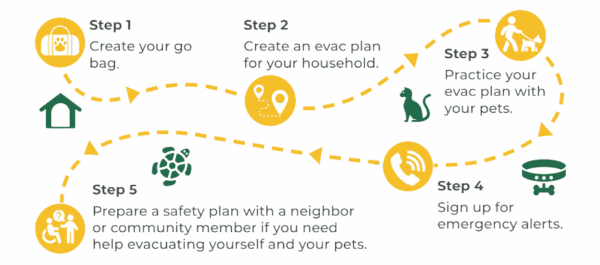
Step 1: Create Your Pet's Go Bag
Pet Go Bags should include essential items, like:
- Water and canned food
- Leashes
- Carriers
- Pet Supplies, including bowls, waste bags, litter, extra tags
- Pet Toys, including blankets and bedding that serve as comfort and stress relief
- Fully stocked first aid kit
- Medications/Prescriptions
You should also have the following readily accessible and organized, ready to pack in your Pet Go Bag:
- Medical Items
- Important documents
- Ownership Records
- Vaccination Records
- Medical History
- Special Care Instructions
- Veterinarian Contacts
Step 2: Create An Evacuation Plan
- Know at least two ways out of your neighborhood. Many states have designated evacuation zones and predetermined evacuation routes.
- Choose a meeting place for your family outside of your neighborhood, and make sure everyone knows where it is.
- Emergency shelters do not necessarily accept pets. Take time to identify pet-friendly shelters in case of an emergency evacuation.
- Share your plan with family and neighbors
Step 3: Practice Your Evacuation Plan
Your Goal is to be Ready to Evacuate in 15 Minutes or Less:
- Set an alarm to begin.
- Start by dressing appropriately for an evacuation.
- Grab your and your pet’s Go Bag, important documents, and anything else you have predetermined that you will bring for you and your pet during an evacuation.
- Pack all your and your pet’s “evacuation essentials” in the car.
- Put your pet in their carrier, kennel, or leash and bring them to the car.
- Once your items are packed in the car and you and your pet are “ready to evacuate,” stop your timer.
Step 4: Sign Up For Emergency Alerts
Step 5: Enlist Help To Support Evacuation
If you need help evacuating yourself and your pets, please prepare a safety plan with a neighbor or community member.
Enlist a trusted person to be available and called upon to care for pets if you are not home.
Microchipping your pet is an important option to consider in the event of a wildfire or general emergency. Microchipping provides permanent and tamper-proof pet identification, which greatly increases the chances of reunification if your pet gets lost during an emergency event or evacuation.
Best Practices and Tips
- Bring pets inside on poor air quality or red flag warning days
- Identify pet friendly shelters
- Sign up for emergency alerts
Types of Evacuation Warnings (via Cal Alerts)
Evacuation Warning
Potential threat to life and/or property.
Those who require additional time to evacuate, and those with pets and livestock should leave now.
Evacuation Order
Immediate threat to life. Leave now!
This is a lawful order to leave now. The area is lawfully closed to public access.
Shelter in Place
Go indoors. Shut and lock doors and windows.
Prepare to self-sustain until further notice and/or contacted by emergency personnel for additional direction.
- Hard Closure: Closed to all traffic except Fire and Law Enforcement.
- Soft Closure: Closed to all traffic except Fire, Law Enforcement and critical Incident resources (i.e. Utility, Caltrans, City/County Roads etc. or those needed to repair or restore infrastructure).
- Resident Only Closure: Soft closure with the additional allowance of residents and local government agencies assisting with response and recovery.
If your neighborhood is under an evacuation alert, locate your pets immediately so you can find them quickly should you need to evacuate!
Help Keep The Pets In Your Community Safe
Wildfires endanger our homes and our communities, including our pets. This is why it’s vital to spread the word on wildfire preparedness and create a network to ensure everyone has the tools and resources necessary to act and keep their pets safe.
Start a neighborhood check-in system
Spread the word about being prepared
Attend Events in your community
Are You a Livestock Owner? Your Wildfire Preparedness Steps are Below!
- Plan for a Wildfire Emergency: Identify the optimal location for livestock confinement during a wildfire. Find alternate sources of water in the event that power is lost or pumps are not working. If possible, install hand pumps as a backup. Your goal should be to have at minimum three days of feed and water available. Create defensible space around your house, barns, and property by clearing the immediate space around those locations of anything that might catch fire, like grass, ornamental or native plants, shrubs, fallen leaves and tree needles, weeds, and combustible mulches including bark and woodchips. Ensure that your firefighting tools are accessible and in one location.
- Plan Your Wildfire Evacuation: Locate multiple potential sites that have the ability to temporarily take your livestock in the event of an evacuation. Learn the evacuation routes to the sites.
- Keep Essential Records: Take photographs and inventory of your livestock. Ensure you have your livestock’s identification records, medical histories, and vaccination records. For identification, you may use permanent identification like microchips, tattoos, brands, or ear tags, or you may use temporary identification, like tags on halters, livestock markets, paint, and duct tape with permanent writing.
- Maintain Transportation: Ensure that your trailers and vans are well-maintained, filled with gas, and ready to be used to transport your livestock. If you do not own a vehicle, set up transportation for your livestock with your neighbors who own vehicles or a local company.
- Participate in the County Livestock Agricultural Pass Program: Check with your county to see if the Livestock Agricultural Pass Program has availability. The Livestock Agricultural Pass Program allows commercial farmers and ranchers limited access to their properties located in restricted areas to conduct essential commercial agricultural activities such as tending to their crops or livestock during or following a natural disaster.
Visit Cal OES, the Governor’s Office of Emergency Services, to learn more about animal evacuations in the case of an emergency.
This project was made possible due to the generous support of AARP, Edison International, and TOPO Collective.